Burntollet Bridge
Say NothingBurntollet Bridge was an old stone crossing over the River Faughan, but in January 1969 its narrow approach became the setting for an ambush that altered the course of a peaceful civil-rights march and, in time, the political convictions of Dolours Price. The bridge’s importance lay in the contrast between the marchers’ public pledge of nonviolence and the violence waiting for them at a constricted country crossing.
Setting and the march
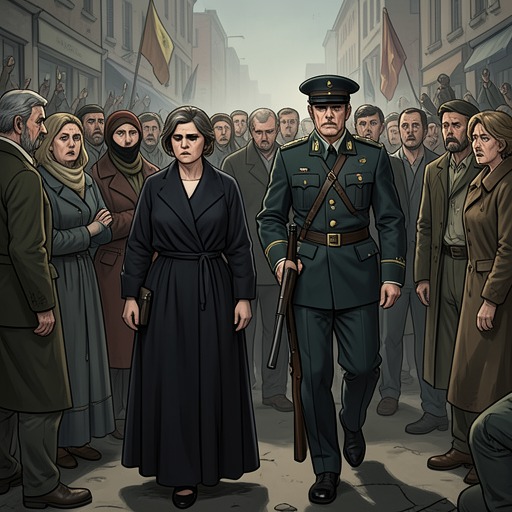
On 1 January 1969, student protesters set out from City Hall in central Belfast on a planned march of roughly seventy miles to Derry. They intended to spend several days walking in protest against the systemic discrimination Catholics faced in Northern Ireland, including exclusion from good jobs and housing and from meaningful political power. The marchers’ route passed through Protestant villages where crowds sometimes blocked their way, while police escorts directed them around the obstructions. By the final day, hundreds of people had joined the procession. Near Burntollet Bridge, the road narrowed between hedges and led into a bottleneck at the old stone crossing. The bridge and its confined approach gave the marchers little room to move when attackers appeared on the rising ground and in the lanes beside them.
The ambush
On the final morning, Eamonn McCann reminded the marchers of their pledge to remain nonviolent and warned that the day would test it. As the procession approached Burntollet Bridge, an old stone crossing over the River Faughan, the lane narrowed between hedges. A lone man on the rising ground above it, wearing a white armband, began making elaborate hand signals; other men appeared along the ridgeline, also marked with white bands. Hundreds of marchers were hemmed into the road, with little space to escape, when rocks began flying.
The assault came from several directions. Men and boys hurled stones, bricks and milk bottles from the fields and lanes, while others tried to block the route at the bridge. Marchers at the front ran toward the crossing as those behind recoiled from the barrage; Dolours Price and Marian Price were caught in the middle. They climbed over a hedge, but attackers followed, swinging cudgels, crowbars, lead pipes and laths. Some carried planks studded with nails. Protesters covered their heads with coats and grabbed one another for protection as the mob pressed in.
People fleeing into the fields were knocked down and kicked, sometimes until they lost consciousness; a young girl was struck in the head with a spade. Two newspaper photographers were beaten and stoned, and attackers seized their film and threatened to kill them if they returned. Ronald Bunting, the march’s grand marshal, was among the attackers, swinging his arms as if conducting the violence. His sleeves were stained with blood; he snatched a protest banner, which someone set alight.
The marchers did not fight back. Price, surrounded by injured young people with blood running into their eyes, splashed into the icy river. In the distance, other marchers were pushed from the bridge into the water. She met the gaze of a man carrying a club and later returned repeatedly in memory to the hatred she saw in his eyes. An officer from the Royal Ulster Constabulary waded in and helped her to safety, but the presence of many other officers had not stopped the attack. It was later alleged that the attackers’ white armbands helped police distinguish them from the marchers; many of Bunting’s men were themselves members of the police auxiliary, the B-Specials.
From protest to armed struggle
The attack’s decisive consequence for Dolours Price was a loss of faith in peaceful protest as a means of changing Northern Ireland. After meeting the gaze of one of her attackers, she concluded that marching would not convert those opposed to change. In 1971, she approached a local commander and joined the Irish Republican Army, taking her oath in the front room of the Price family home. She later understood that step as a return to the republican convictions on which her family’s legacy had been built. Marian Price joined the Provisionals as well; their transition from students by day to clandestine members by night followed the attack that had left both sisters changed.
The ambush also became a point of dispute over women’s place in the movement. When Seán Mac Stíofáin initially proposed that Dolours join Cumann na mBan, the female auxiliary, she rejected a supporting role and insisted on serving as a fighting soldier. A special meeting of the Provisionals’ Army Council then decided that women could become full members. The book presents her ambition and republican family background as important factors, while also noting her own suggestion that the mass imprisonment of men may have pushed the organization to admit women. The political turn that began at the bridge thus extended beyond one march: an attack on nonviolent demonstrators helped propel Price toward armed action and a challenge to the gender boundaries within the organization she joined.
Memory, Representation, and Historical Weight
Burntollet Bridge returned in the book not only as the site of an attack but as a place whose meaning followed Dolours Price into later events. On the night before the 1973 London bombings, she and Marian went to see Brian Friel’s play The Freedom of the City. Its three civil-rights protesters take refuge in Derry’s Guildhall, where the press and British Army mistake them for armed insurgents; the play ends with their deaths and an inquiry that justifies the shooting. The Guildhall was also where Ian Paisley and Major Bunting had rallied supporters before the march reached the ambush. The theatrical echo connected the two moments through a recurring misreading: peaceful protest recast as militant threat, with violence and its official interpretation following close behind.
Stephen Rea, who acted in the play, had known Price from the student protests. Years later, he recalled that the London audience received the production “in a frost of ignorance.” For Price, watching a civil-rights marcher mistaken for an IRA member on the eve of an operation she was about to undertake brought the political and personal histories surrounding Burntollet into sharp proximity. The play did not recreate the bridge attack; rather, its story of protest, suspicion and retrospective justification made the earlier assault newly legible within the book’s account of her trajectory.
The book treats the bridge as a remembered turning point, while also making clear that memory is not a simple substitute for verification. Its note on sources describes a four-year investigation and explains that individual recollections were corroborated wherever possible; where accounts diverged, the main narrative uses the most plausible version and discusses alternatives in the notes. That method matters to a place whose significance rests partly on how survivors remembered what happened there. Burntollet Bridge remains both a physical bottleneck on the road to Derry and a hinge in the narrative: a protest committed to nonviolence met an organized assault, and the meaning of that encounter continued to surface in later choices, art and contested recollection.